Anna Maria BALINT
- TOP >
- Archives >
- Residency Program >
- Anna Maria BALINT
Exchange Residency Program
(International Creators from abroad)
update: 2026.1.16
Anna Maria BALINT
| Participating Project | Exchange Residency Program (Creators from abroad) |
|---|---|
| Activity Based | Basel (Switzerland) |
| City / Place stayed | Tokyo |
| Period | 2026.1 - 2026.3 |
Purpose of the residency
During the residency, I will immerse myself in Tokyo’s everyday spaces, exploring how material, transience, and object culture are lived and experienced. My primary focus will be on textile materials, researching local fabrics in places like Nippori Fabric Town. Simultaneously, I will observe in-between spaces, architecture, and interiors, capturing these situations through drawings that can later be translated into sculptural works. I will research and collect ideas for a future series centered on the paravent as a space-dividing, translucent, multidimensional object. The residency will be a period of focused observation, material exploration, and reflection.
Plan during the residency
- Research textile materials and local fabrics, including visits to places like Nippori Fabric Town
- Research and collect ideas for a future series of sculptures focused on the paravent
- Make water color drawings to capture my visual impressions and memory of my stay
- Create sketches for a new sculptural work series
- Observe and study in-between spaces, interiors, and architecture in Tokyo
Activities during the residency
During my residency in Tokyo, I focused on textiles and traditional Japanese interior elements such as Shōji. I was interested in how structure appears both in fabric, in architecture and interior, especially in the repetition of grids and patterns. While moving through the city, I observed buildings and their facades, noticing how structured and layered they are, almost like woven surfaces. This comparison between textile and architecture slowly developed through everyday observation. At the same time, I tried to find places with traditional interiors, which was not easy in contemporary Tokyo. Therefore I visited several reconstructed historical sites and architectures like the Edo-Tokyo Open Air Architectural Museum to see preserved reproduced buildings and their interiors. Furthermore I began my material research in Nippori Fabric Town and the Okaya Silk Factory to learn more about materials and textile production of Japan.
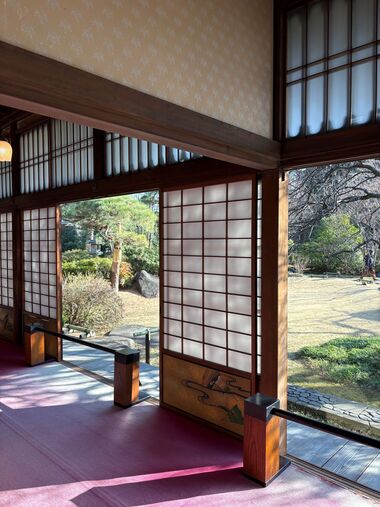
Research Trip to Edo Open Air Architectural Museum
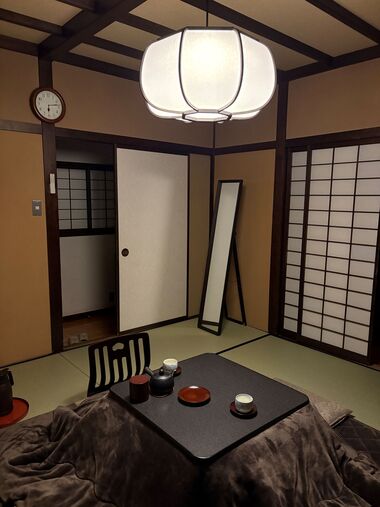
Room in the Ryokan in Matsumoto
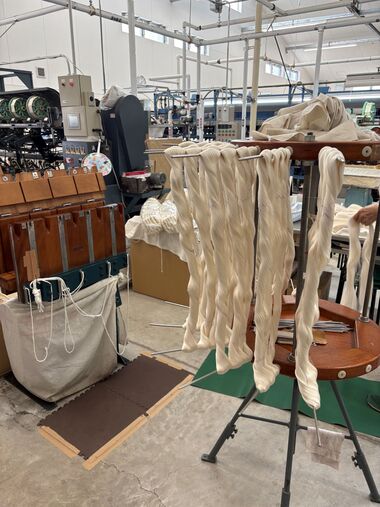
Insight into the Silk Factory Okaya
Outcome of the residency
During the time in Tokyo, I gradually found a way of connecting my interests in textiles, architecture and interior. Rather than working towards a clear result, it was more about paying attention to how similar structures appear in different contexts — in fabrics, in building facades, and in the way spaces are organized which informed my research. Walking through Tokyo and visiting different places, I collected impressions that I also recorded in watercolor drawings, functioning as a kind of visual notebook. These drawings were less about documentation and more about holding fleeting observations — textures, structures, and atmospheres that I encountered in the city. Staying at a Ryokan in Matsumoto— a traditional Japanese inn — felt like adding the missing piece to my research, as it allowed me to inhabit a place and spend time within it, rather than just moving through it. The experience of being in this kind of interior space made the relationship between structure, material, and everyday use more tangible. Small details — the proportions of rooms, the materials, the light — became part of a slower, more embodied way of observing. I worked with small maquettes as a way to translate some of these observations into a more physical and spatial thinking process. They were not fixed models, but a form through which my research could be presented at the Open Studios. This experience made me realize how important it is for me to spend more time on research within my artistic practice, allowing these impressions to gradually develop into a new series of work.
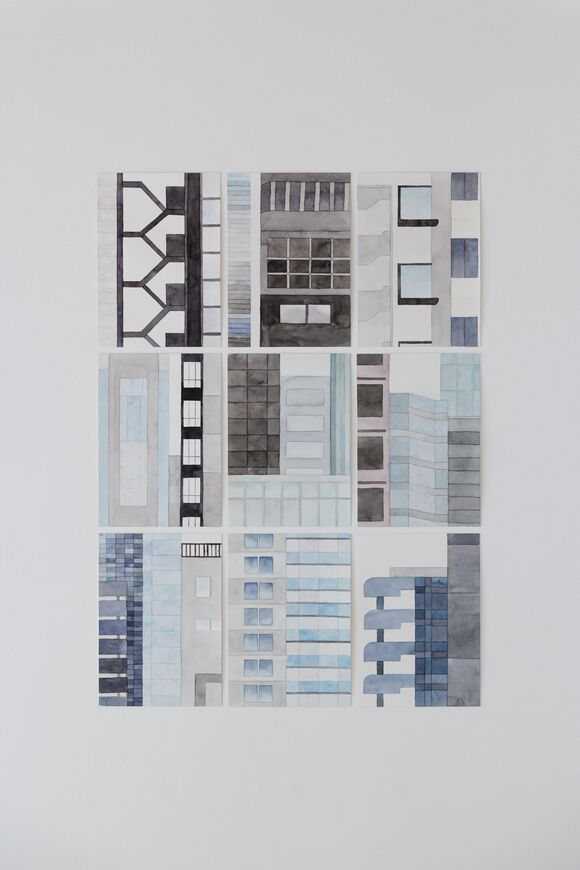
2026, series of nine watercolor drawings on paper
Photo: MANIWA Yuki
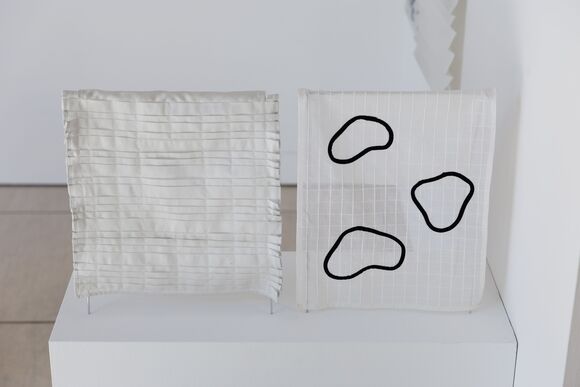
2026, Maquettes made from silk, cotton and stainless steel
Photo: MANIWA Yuki
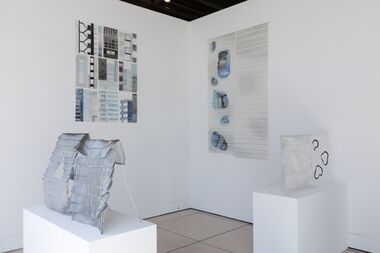
2026, Exhibition view at the Open Studio
Photo: MANIWA Yuki
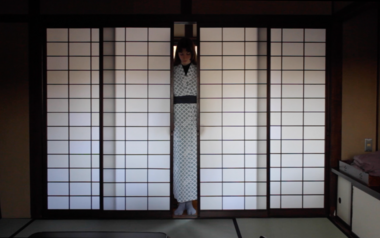
2026, Videostill from a short video made for the presentation at the Open Studio
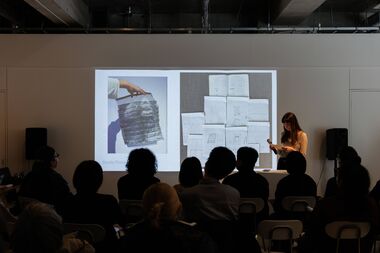
2026, Open Studio Presentation
Photo: MANIWA Yuki
Our Facilities