Mihnea MIRCAN
- TOP >
- Archives >
- Residency Program >
- Mihnea MIRCAN
Curator Residency Program
update: 2026.3.18
Mihnea MIRCAN
| Participating Project | Curator Residency Program |
|---|---|
| Activity Base | Bucharest (Romania) |
| City / Place stayed | Tokyo |
| Period | 2025.10 - 2025.11 |
Purpose of the residency
My current research is centered on the topic of metamorphosis: the situation where, finding itself in mortal danger, a body changes into another body and adopts a new way of being in the world. In this reconfigured relation between figure and ground, both self and environment are transformed. I work with images of metamorphosis to create an archive of gestures that describe being in a crisis. This repertory of critical performances, that permit the endurance of mythical creatures and their contemporary descendants, are responses to today’s emergencies: collections of other bodies, somatheques from which we learn what we might become in a world transformed by forces beyond our control, metamorphoses that short-circuit between the change of the person and that of its environment.
The residency would be a fantastic opportunity to expand the geographical purview of my investigation into metamorphosis, to learn, within a different cultural context, about the connections between metamorphosis, in myth or in contemporary practice, and the questions or anxieties of the present moment. Myths perform a particular symbolic function: saying something that cannot otherwise be said, the myth’s paradoxes, illogic or physical impossibility create a scene of collective consolation in the present. In the hands of contemporary artists, such narratives and allegorical devices become telescopic lenses that zoom between past and future, chaos and form.
Plan during the residency
In Japan, I hope to understand the ways in which myths of transformation are reiterated, as responses to questions in the societal self-perception, as means for art to probe history and the present. My initial question is quite simply “why are myths retold?”, which needs, crises, senses of collective danger or comfort do they answer, what is the relation between the fiction of metamorphosis and the real world. Myths of transformation enlist the non-human in role laden with human signifiers, so that the monster, the ghost, the hybrid, the animal, the other body are conferred personhood: made human and de-humanized at the same time, they embody the ecstasy and misery of being human.
I want to study the ways in which these forces and transfers are organized in the specific Japanese context, in artworks and artistic practices I would be able to experience first-hand, but also as evolving cultural discourses as these appear in the research of folklorists, anthropologists and cultural historians.
Activities during the residency
During my residency I focused on polymetallic nodules, small seabed geological formations that accreted 15 million years ago around shark teeth and whale bones, at depths of 4-5 km, whose mineral constitution includes significant quantities of rare earths, vital for technologies of communication and energy storage. Japan is probably the most advanced country in the world in its program to exploit the nodule deposit around Minamitorishima island. I explored the different museological contexts in which nodules are presented in Tokyo – science and innovation galleries, mineralogical collections and a technology fair – each equipped with its own ideological framework around the fraught questions of deep-sea mining and ecology, resource extraction and economic stagnation. My research also considered the nodules as metamorphic aggregates of bone, stone and breath, as a case study of organic and inorganic transformation at a time of planetary upheaval and polycrisis.
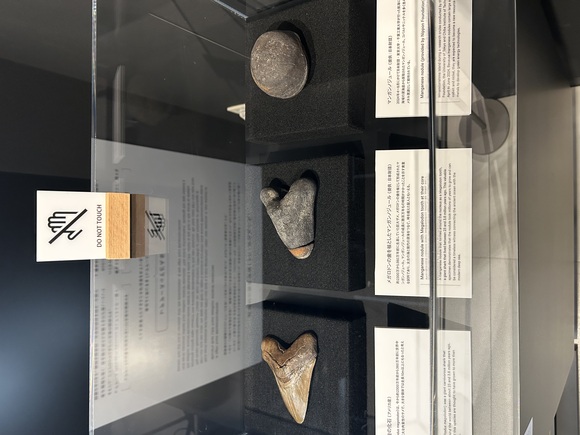
Research picture: Ciba Institute of Technology
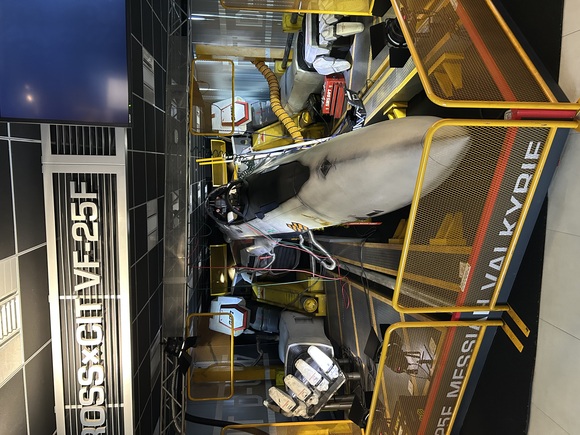
Research picture: Ciba Institute of Technology
Outcome of the residency
My research – geared especially towards a significant exhibition I will curate in Romania in 2027 – has progressed quite substantially over the course of residency. I have much consolidated my understanding of polymetallic nodules, of their economic and ecological role, of their function as small hinges in narratives about the contemporary world, and I was also able to develop speculative tangents away from a purely scientific story, towards artistic practices and key artistic moments. Just as an example out of many, the encounter with the work made by On Kawara in Tokyo between 1952-56, well before becoming a canonical exponent of conceptual art, allowed me to reflect on connections between states and metaphors of petrification and liquefaction, incandescence and flooding. The residency has thus been a crucial steppingstone towards a project that will mark a significant moment in my work as a curator.
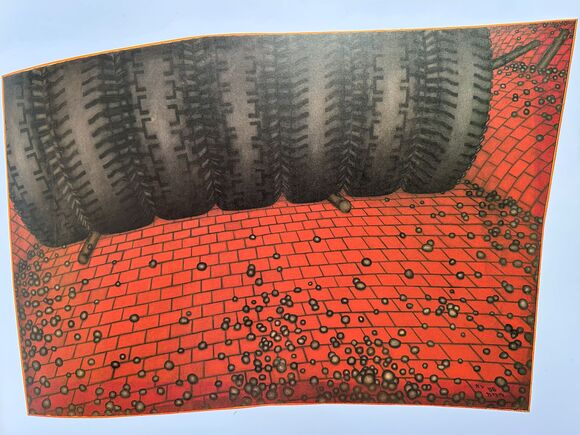
On Kawara, Stones Thrown, oil on canvas, 1956
Parco Gallery catalogue, collection of MoMA NY
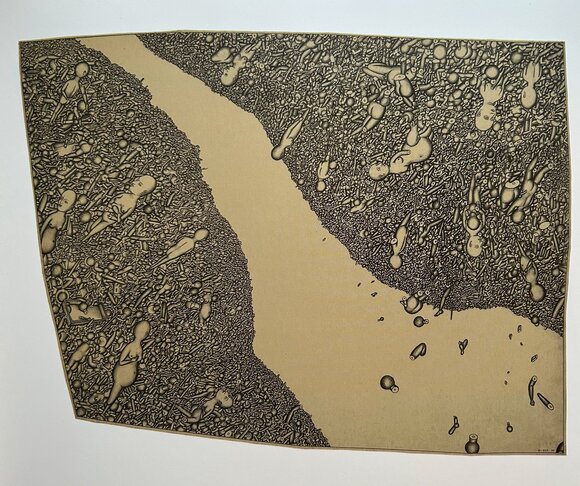
On Kawara, Dump, oil on canvas, 1956
Parco Gallery catalogue, collection of MoMA NY
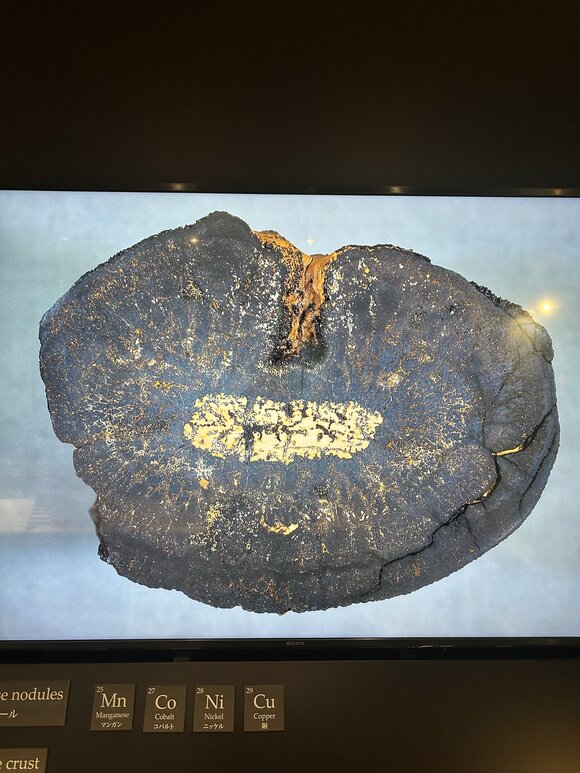
Research picture: Minerafront, University of Tokyo
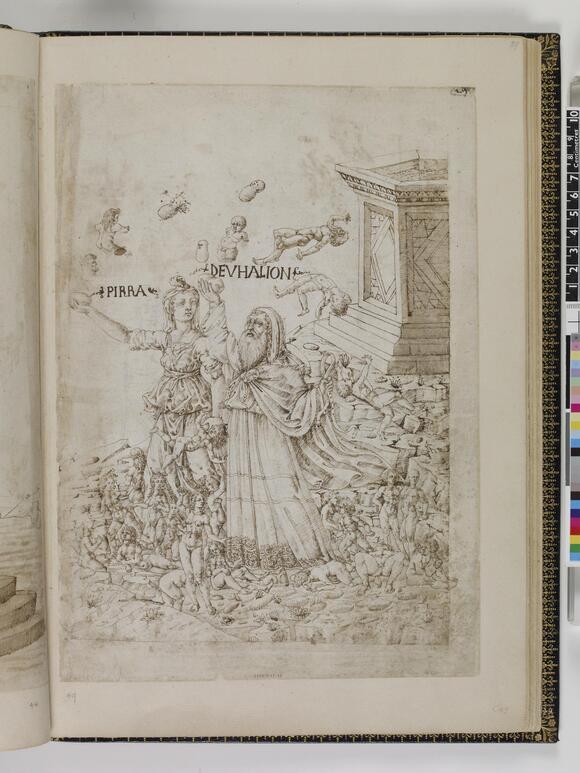
Maso Finiguerra, Deucalion and Pyrrha, drawing from The Florentine Picture Chronicle, circa 1473
Book at British Museum
Our Facilities