KOBAYASHI Yuki “The Wing Chun Project”
- TOP >
- Archives >
- Exhibitions / Performances >
- KOBAYASHI Yuki “The Wing Chun Project”
KOBAYASHI Yuki “The Wing Chun Project”
OPEN SITE 10 | Open Call Program【dot】
“The Wing Chun Project” (2019-) is an interdisciplinary performance project based on Wing Chun, a Southern Chinese martial art founded by a Shaolin monk and kung-fu practitioner named Ng Mui. In this project, Kobayashi explores her ideas, the history of war and colonial rule in East Asia, both of which are closely related to the development of Wing Chun, and the meaning of studying fighting and self-defense in contemporary society as a performance artist using the body as a medium.
| Period | Dec 16 (Tue) - Dec 21 (Sun), 2025 |
|---|---|
| Time | 11:00-19:00 |
| Admission | Free |
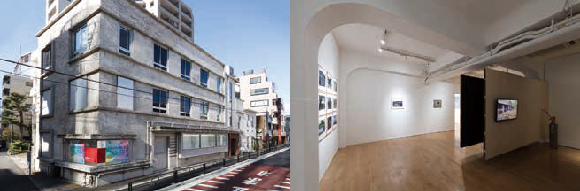
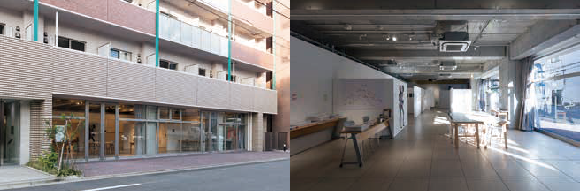
| Venue | Tokyo Arts and Space Hongo: Space C (3F) |
| Support | Arts Commission Yokohama (ACY), MPP Totsuka, Taiyo Construction, Ohashi Waves, Meirin Shinkiba, Tokyo Kanezyu |
Timetable
The artist will be practicing in the venue throughout the execution period, except for workshop/performance time.
Workshop
| Date | Dec 16 (Tue), Dec 17 (Wed), Dec 18 (Thu) 17:00-18:30 |
|---|---|
| Admission | Free - Booking required - Booking opens from 14:00 on Sep 12 (Fri), 2025. - Booking will close if it's sold out or at 17:00 the day before the workshop. |
| Venue | Tokyo Arts and Space Hongo: Space C (3F) |

Ticket bookings available from 14:00 on September 12 (Fri)!
Go to the booking website (Peatix).
*Peatix account required to book tickets.
Performance
| Date | Dec 19 (Fri) 17:30-18:30 Dec 20 (Sat) 14:30-15:30 *Post-show talk 15:40-16:30 Dec 21 (Sun) 14:30-15:30 |
|---|---|
| Admission | Free - Booking required, all seats are unreserved. - Booking opens from 14:00 on Sep 12 (Fri), 2025. - Booking will close if seats are sold out or at 17:00 the day before the performance. |
| Venue | Tokyo Arts and Space Hongo: Space C (3F) |
Ticket bookings available from 14:00 on September 12 (Fri)!
Go to the booking website (Peatix).
*Peatix account required to book tickets.
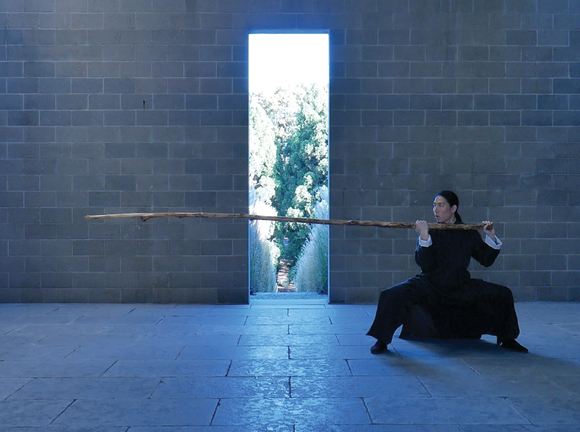
Documentation of the Performance in The Watermill Center 2024
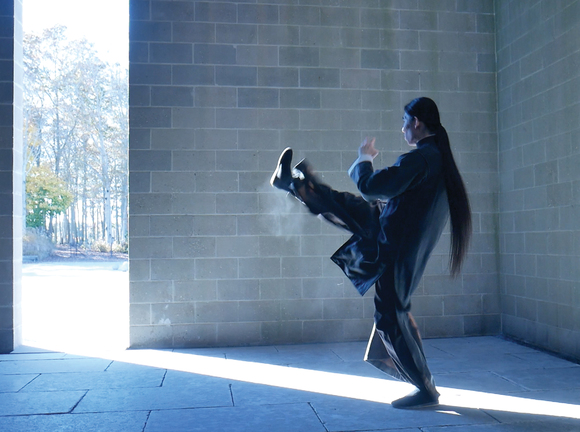
Documentation of the Performance in The Watermill Center 2024
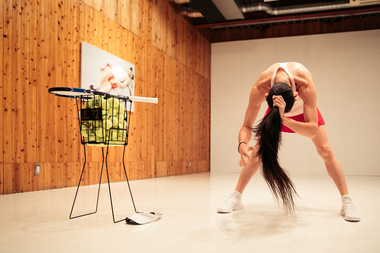
Chromosome 2018
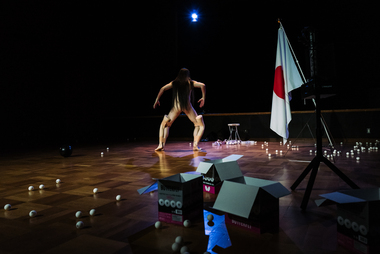
Battlecry 2022
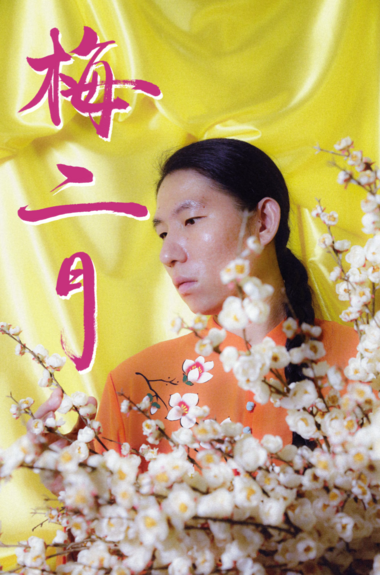
Profile
Kobayashi Yuki explores the neutrality of gender and questions racial stereotypes, while using his own body to
explore human relations and the resonance between restriction and fluidity in time and space. His interdisciplinary
performances challenge power and restrictive social codes as a means of attaining a more uncertain world of freedom
and equality. Recent activities: “The Watermill Center 2024 Artist-In-Residence,” The Watermill Center, New York, “www.
Reversal Database.commons /www. 反轉資料庫.commons,” Taipei Fine Arts Museum, Taiwan, 2024, “CHAT 5th Anniversary - Factory of Tomorrow,” Hong Kong, 2024. Arts Commission Yokohama ACY Artist Fellowship, 2025.
http://yukikoba.com/
Review
Between Acceptance and Rejection
KOBAYASHI Haruo (OPEN SITE 10 Jury member)
In his practice thus far, Kobayashi Yuki has turned himself into a genderless, nonhuman strawberry, worn the uniforms of professional sports and Olympic events, trained until collapse, and, in simpler contexts, placed stress on his own body and laid it bare in the most literal sense. Through these acts, he has foregrounded the social pressures that can bear down on the body, while suggesting, through performance, the body’s potential for transformation.
Kobayashi’s “The Wing Chun Project” was not a work that began and ended with an exhibition or a performance. Instead, the project in its current stage—encompassing daily training, workshops, research, and lectures—was transferred in its entirety to a gallery space at TOKAS. When I went to view it, I was particularly eager to see the transformation of the gallery into a martial arts dojo, where daily practice, usually kept behind the scenes, would be presented as an extension of the work itself.
Beforehand, I imagined the room steeped in a quiet, almost suspended stillness, with Kobayashi practicing alone in silent concentration. The workshop I took part in, however, was something else entirely. After learning a distinctive standing posture and several hand forms, we quickly formed pairs, and the session centered on chi sao, a paired exercise in which two practitioners keep their arms in constant contact. Wing Chun is built around the repeated practice of chi sao, and far from being solitary, it is striking in the way the practitioner comes to take in even a partner’s breathing as part of their own bodily rhythm. At the end of the workshop, we practiced chi sao with our eyes closed, and I experienced a strange sensation: both my own movements and my partner’s felt clearer and more perceptible than when watching them with my eyes open.
Kobayashi’s physique bears the marks of an athletic life that began in childhood. In high school, he was accomplished enough to be selected for an elite tennis program. After entering university, he led a double life, studying art while immersing himself in tennis practice, before turning his full attention to art.
A body trained toward a single goal seems to be burdened with more than physical strain alone. It is also shaped by competitive, male-dominated structures, by the demands of politics and commercial interests at any given moment, and by the coarse, biased gaze of the public. The solitary body of the athlete is unjustly exposed to such pressures. The constraints Kobayashi felt firsthand as an athlete later came, paradoxically, to occupy the core of his work’s conceptual framework once he gained physical freedom and focused on the study and practice of art.
The Wing Chun Project would seem to be an extension of this arc. When Kobayashi appears in a changpao (traditional Chinese robe), the atmosphere recalls his earlier work, but the sense of wholehearted commitment feels decisively different. When I asked him about this, he told me that through this project, elements that had previously been only isolated fragments had come into view as a comprehensive whole. Why, then, Wing Chun?
Among martial arts—a field generally strongly associated with masculine imagery—Wing Chun was founded by a woman more than 300 years ago and developed as a practical, defense-oriented discipline rooted in everyday life, rather than in traditional forms of kung fu. Was it this sense of anomaly that led Kobayashi to intuit a queer point of connection with his own work?
The Wing Chun Project began in 2019, when Kobayashi started training under sifu (teacher) Tanaka Masaya of the Kyoto Wing Chun and Hung Kuen Training Group. He later developed it into an art project, making use of various grant programs to travel to dojo in Hong Kong and mainland China, where he learned techniques directly, and he has already obtained instructor certification. Meanwhile, the project has also involved visiting places associated with Wing Chun to trace its historical narrative. As this process unfolded, the complex and often turbulent history of Wing Chun gradually came into focus. Influenced by periods of social upheaval such as the Chinese Civil War and the Second Sino-Japanese War, Wing Chun spread across different regions, branching into many lineages as a range of factors shaped differences in interpretation and basic poses and movements. Over time, a surprisingly mixed set of elements became closely entangled, and what began as a practical combat technique has continued to shift in purpose and meaning up to the present.
Perhaps Kobayashi has attuned himself to Wing Chun because it is a single technique that has endured over long periods while being shaped by complex social forces, and as such, it relates to the single body exposed to various pressures that has been the focus of his practice thus far. By learning this martial art, he may be trying to move away both from the inevitable artifice of art and from the goal-driven logic intrinsic to sports, and to explore Wing Chun’s potential as a more practical method for dialogue.
His aims may be to rejoin what has been treated, through repeated acts of conceptualization, as a body broken up and converted into discrete works, to restore it as a single, continuous body, and to live differently, with the sense that daily life, time, and experience form an unbroken whole.
On display at the venue are martial arts implements including a wooden dummy, paired butterfly swords, and the long pole used in the luk dim bun gwan pole form. The lecture-performance held in the gallery traced the development of the project, beginning with the basic forms of Wing Chun, then incorporating shapes and movements from different lineages, including poses and movements modeled on the snake and the crane, and proceeding step by step to demonstrations using the weapons on display.
As the performance intensified, the force of the movements and the sharp sounds of weapons striking heightened the tension in the room. The “branches” of the wooden dummy’s arms and the long pole were replaced with sticks Kobayashi had fashioned himself from pieces of driftwood gathered along the shore. A cloth sack filled with sawdust was pressed against the wall and struck repeatedly. As the scent of wood spread through the space, it became apparent that the demonstration was shifting away from established forms and toward Kobayashi’s own performance. The organically shaped sticks, slowly polished to reduce the straight, aggressive force of conventional weapons, resisted being used as compliant tools. At times they appeared like living snakes, at others like male genitalia, and together with cryptic acts veering into self-harm and sexuality, they reshaped the atmosphere in the room into a new and twisted form.
As the performer became completely absorbed in the actions, the sense of openness present until then abruptly vanished, giving way to a feeling of alienation, as if the audience had been pushed aside. This ambivalence lies at the heart of the catharsis found in Kobayashi’s work, and is also the point of departure for this project.
KOBAYASHI Haruo
Director of blanClass, artist. Born in Kanagawa in 1968. Director of B-semi from 2001 to 2004. He founded blanClass in 2009 and has organised numerous live events as a platform for disseminating art. His current activities center on archive management, external art projects, etc.
Participating Creator
Our Facilities