MARUYAMA Shoya “Virtual Field Recording –Listening to the Voices of All Things–”
- TOP >
- Archives >
- Exhibitions / Performances >
- MARUYAMA Shoya “Virtual Field Recording –Listening to the Voices of All Things–”
MARUYAMA Shoya “Virtual Field Recording –Listening to the Voices of All Things–”
OPEN SITE 10 | Open Call Program【Exhibition】
This participatory installation invites visitors to “listen to the voices of all things” by attending closely to layered sounds found in nature, cities, and human-made structures within a simulated environment. As they navigate this space using multiple recording devices, the recorded sounds are played through speakers in the venue, reconstructing a soundscape in physical space. By gathering sound in a virtual space, the work reexamines the act of listening, its meanings, and its possibilities.
| Period | Oct 11 (Sat) - Nov 9 (Sun), 2025 |
|---|---|
| Closed | Mondays (except Oct 13, Nov 3), Oct 14, Nov 4 |
| Time | 11:00-19:00 |
| Admission | Free |
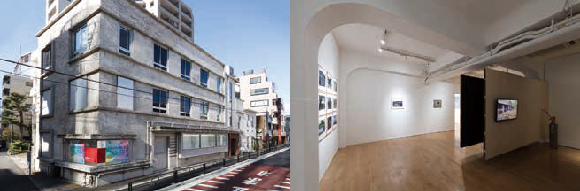
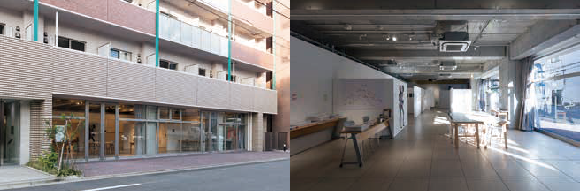
| Venue | Tokyo Arts and Space Hongo: Space B (2F) |
| Support | Project to Support Emerging Media Arts Creators, 2024 |
| Technical cooperation | ISHIHARA Koh (Game system), TAKAHASHI Yusuke (World Design), SHIMIZU Rinna (Furniture Design) |
| Equipment cooperation | Audio-Technica Corporation, Konel Inc. |
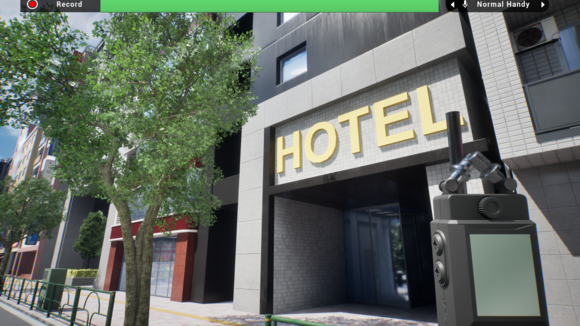
Pluralistic Orchestra 2025
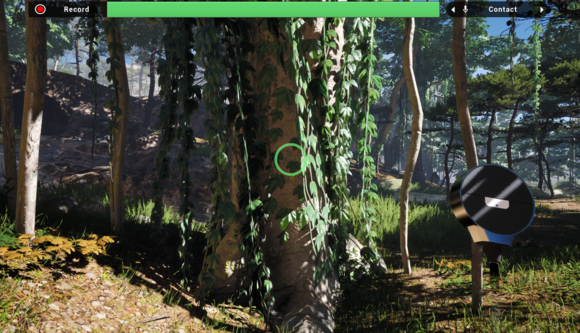
Pluralistic Orchestra 2025
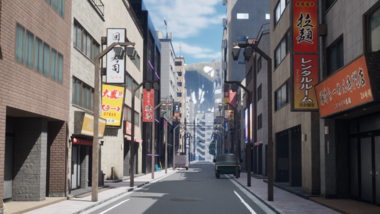
Pluralistic Orchestra 2025
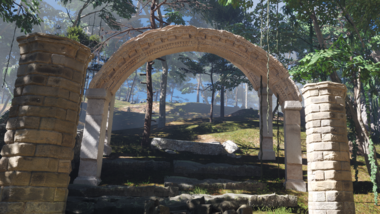
Pluralistic Orchestra 2025
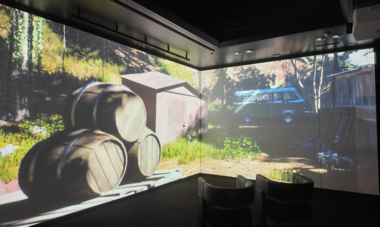
Pluralistic Orchestra 2025
Related Event
Talk “Reimagining the Act of Listening: Between Technology and Perception”
Microphones, headphones, field recorders—and now, virtual environments. Technological advancements have continually reshaped the way we listen. But as our tools evolve, how does our relationship with the world transform in turn?
In this talk, we welcome Ito Asa, a scholar of aesthetics and embodied perception, and Yanagisawa Eisuke, a field recordist who has traveled the globe capturing the hidden layers of sound. Together, they will explore how technology transforms the act of listening, and how such shifts may lead to new forms of connection between humans and their environments.
Drawing from the exhibition, where visitors collect sound within a simulated world, this conversation asks: What happens when listening becomes a way of reconstructing reality rather than merely perceiving it? Join us as we reflect on the future of listening—and how sound may reshape the very way we relate to the world around us.
| Date | Nov 2 (Sun) 15:00-16:30 |
|---|---|
| Guests | ITO Asa (Aesthetician) YANAGISAWA Eisuke (Ethnographer, Field recordist) |
| Admission | Free |
| Venue | Tokyo Arts and Space Hongo: Space B (2F) |
| Language | Japanese |
Profile
Maruyama Shoya is a sound artist whose practice involves multifaceted forms of listening, exploring perceptions of sounds produced by others and surrounding environments while reflecting recursively on his own listening. In recent years, his work has examined auditory agency through the act of listening in both physical and virtual spaces.
Recent exhibitions: Project to Support Emerging Media Arts Creators Event “ENCOUNTERS,” TODA HALL &
CONFERENCE TOKYO, 2025, “ARTBAY TOKYO ART FESTIVAL 2024,” Miraikan.
shoyamaruyama.notion.site/
Catalog
To download the catalogs of "OPEN SITE 10," please click here.
Review
The Contours of Sound Recording:
Maruyama Shoya’s “Virtual Field Recording: Listening to the Voices of All Things”
KANEKO Tomotaro (OPEN SITE 10 Jury member)
One of the pleasures of listening to field recordings is the experience of reflecting, through technology, on the contours of one’s own sense of hearing. Human hearing operates through many innate and learned filters and is linked to other senses. Sound recording, by contrast, is shaped by filters unlike those of the human body and stands apart from other forms of sensory input. A listener encounters a way of hearing different from their own and measures it against how they usually perceive sound. When one recognizes the disconnect between the two, the contours of hearing that once felt natural begin to shift. This sensation is pleasurable and rich in discovery, and it can leave an imprint on our daily lives.
Maruyama Shoya’s solo exhibition “Virtual Field Recording: Listening to the Voices of All Things” centers on the installation Pluralistic Orchestra, which enables viewers to practice field recording within a video game. Playing it while listening to Maruyama’s commentary, I felt that the work does not lead to the kind of experience described above. A viewer’s attention turns less toward listening itself and more toward the active practice of field recording. Through the format of a game, this work offers opportunities to enjoy and to reexamine the act of recording.
In terms of listening, Pluralistic Orchestra conveys a sense of confinement, one that does not open toward a comparison-based relationship with reality. The sounds viewers record are drawn largely from recordings Maruyama made in the real world, making them copies of copies. The gap between actual sounds and recordings of them, an unavoidable feature of ordinary field recording, is absent here. Viewers are twice removed from reality, circling among the environmental sounds of an artificial world and the sounds captured within it. There are, of course, forms of art in which the distinction between real and artificial sound has little bearing. However, because this work takes field recording as its subject, its use of sounds originally recorded in the real world paradoxically creates the impression that its connection to reality is faint.
Maruyama emphasizes that “traces of the act of listening itself” remain in this work. In my view, this too contributes to the sense of confinement. Records of play accumulate as data within the system, yet the viewer is never shown a full picture of what others have left behind. The implementation of Bernie Krause’s “acoustic niche hypothesis,” which proposes that each species occupies its own sonic space within an ecosystem, as if it were an underlying truth further strengthens the sense that listening is being managed by the system. The exhibition’s subtitle, “Listening to the Voices of All Things,” also underscores the artist’s omniscience as creator of this artificial world. The impression that one is hearing sounds supplied by the artist never fully disappears.
More than listening, in Pluralistic Orchestra it is sound recording that drives the game. Probably to sustain viewers’ interest, Maruyama has built in a range of recording-related strategies: uncovering hidden sounds using the microphone’s range of capabilities, collecting different microphones for that purpose, inferring the inner states of others from concealed sounds. These elements recall the pleasures once emphasized in earlier outdoor sound recording culture.
Pluralistic Orchestra consists of three stages. In the first, a city map, viewers can hear not only the sounds emitted by visible objects on the screen but also sounds inside buildings by zooming the microphone. In the second, a nature map, they can collect specialized microphones (a contact microphone, a hydrophone, a signal scope) and expand the range of the audible. In the final stage, which returns to the city map, they can use equipment obtained in the nature map to listen to what people around them are hearing and infer the intentions behind their actions.
The desire to extend hearing through microphones recalls how, before the term “field recording” became common in art, outdoor sound recording practices were once referred to as “sound hunting.” The senses in general —and hearing in particular, when compared to vision—tend to be regarded as passive. There is no word equivalent to “gaze” for the ears. However, the act of pointing a microphone at a subject and recording reveals an active desire underlying hearing. Pluralistic Orchestra brings this sense of active agency to the fore through the format of a game and makes it the engine of its experience. The desire to extend hearing represents one way the contours of sound “recording” have been redefined over time, through the history of field recording.
Earlier, I noted that in the listening experience it delivers, Pluralistic Orchestra conveys a sense of confinement, as if removed from reality. However, the work includes one feature that offers a glimpse of Maruyama’s own approach to recording sounds in the real world. Once viewers begin recording, they are unable to use any functions for the first minute. In an ordinary video game, this would seem like an extremely frustrating freeze, but here it evokes the figure of Maruyama holding himself still so as to interfere as little as possible with the sound source. Through this stillness, the act of listening and the act of sound recording, both carried out in silence, are linked.
KANEKO Tomotaro
Associate Professor, Department of Fine Arts, Aichi University of the Arts. His field is aesthetics, and aural culture. He has organized the Japanese Art Sound Archive since 2017.
Participating Creator
Our Facilities