FUJITA Kazuki “Zanteiteki ni Bunshin”
- TOP >
- Archives >
- Exhibitions / Performances >
- FUJITA Kazuki “Zanteiteki ni Bunshin”
FUJITA Kazuki “Zanteiteki ni Bunshin”
OPEN SITE 10 | Open Call Program【Performance】
Is it possible to find connection while remaining physically disconnected
from society? Focusing on the body that seeks both separation from
and connection to society, this solo dance performance expresses that
contradictory desire through aimless interaction with discarded everyday
objects. Drawing from the artist’s own long-term experience of school
refusal, the work reflects on the body isolated from existing social
structures through practices open to improvisation and chance.
| Dates | Oct 17 (Fri), 2025 19:00-
Oct 18 (Sat), 2025 14:00- / 17:30- Oct 19 (Sun), 2025 14:00- *15:00- Talk | Guest: TAKATA Fuyuhiko (Artist) *Available only in Japanese. *The talk of Oct 19 is also open to the attendees of Oct 17 or 18. *About shooting - The performance will be filmed. - Photographs and videos taken at the venue will be used as a record of the program and may be shown on the TOKAS website, SNS, YouTube, etc. They may also be used for publicity purposes, etc., in addition to being shown on the artists' websites and in exhibitions. |
|---|---|
| Ticket | 2,000 yen - Booking required, all seats are unreserved. - Booking opens from 14:00 on Sep 12 (Fri), 2025. - Booking will close if seats are sold out or at 17:00 the day before the performance. |
| Venue | Tokyo Arts and Space Hongo: Space C (3F) |
| Concept, choreography, performance | FUJITA Kazuki |
| Sound design | NAKAHARA Raku (KARABINER inc.) |
| Delegated production (France) | cohue – Lucille BELLAND |
| Support | Steep Slope Studio, MIYAKUBO Maki |
| Ticket information | - Booking for the performance on Oct 17 (Fri), 19:00- is closed. A few tickets without reservation are available at the door 15min before the performance (cash only). (10/16) - Booking for the performance on Oct 18 (Sat), 14:00- is closed. A few tickets without reservation are available at the door one hour before the performance (cash only). (10/17) - Booking for the performance on Oct 18 (Sat), 17:30- is closed. Tickets without reservation are available at the door one hour before the performance (cash only). (10/17) - Booking for the performance on Oct 19 (Sun), 14:00- is closed. A few tickets without reservation are available at the door one hour before the performance (cash only). (10/18) |

Ticket bookings available from 14:00 on September 12 (Fri)!
Go to the booking website (Peatix).
*Peatix account required to book tickets.
*Project developed with the support of ICI – Centre chorégraphique national Montpellier Occitanie / Direction Christian Rizzo as part of the postexerce insertion support fund with the support of DRAC Occitanie.
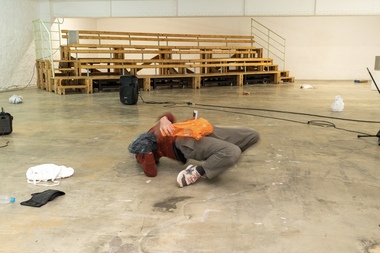
Contes de la déviation 2025 Photo: Hubert CRABIÈRES
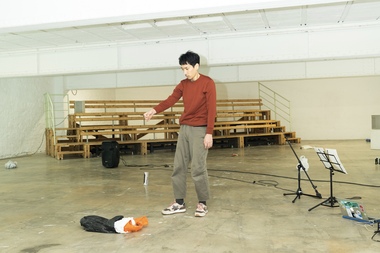
Contes de la déviation 2025 Photo: Hubert CRABIÈRES
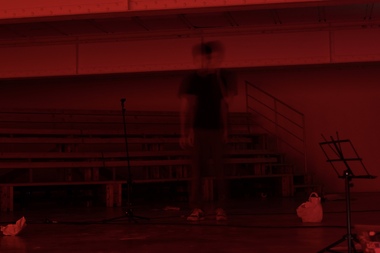
Contes de la déviation 2025 Photo: Hubert CRABIÈRES
Profile
Fujita Kazuki is a dancer and choreographer based in Paris and Kanagawa. His work explores the process of
translating words into gestures and vice versa through experimental performances that take inconsistencies, misalignments,
and misunderstandings as points of departure. Recent activities: “Contes de la déviation,” Residence, Ménagerie de Verre,
Paris, 2025, performed in River Lin “My body is a public collection,” MuCEM, Marseille, France, 2024.
https://kazukifujita.com/
Review
Living on the Threshold: The Externalized Mind as Another “Room”
KOBAYASHI Haruo (OPEN SITE 10 Jury member)
Fujita Kazuki is an artist based in Paris and Kanagawa whose work centers on dance. In this piece, he addresses his own experience of spending more than 10 years away from school during his childhood, before moving to France in 2015. It is an endeavor to make sense of a personal history that might otherwise suggest a simple loss of connection with society, and to reframe that history as the creative source of the work he does now.
Fujita studied contemporary theater in Japan and began dancing seriously after arriving in Paris. He became interested in verbal communication, and in the broadly defined act of translation—shifting what is said into another language or into physical action and then bringing it back into words. However, every translation has its gaps, as no two languages fully map onto one another and something is always lost in the process.
For Fujita, what lies outside the scope of the Japanese and French languages, or even the movements of dance, is a kind of sensation that lingers in his mind. It may resemble the shapeless impressions that once lingered in his mind and body when he spent long hours turning questions over by himself in his room, unable at times to express anything outwardly.
When I first saw the space Fujita constructed, I immediately assumed it was an enclosed room. But the room shown here is not a living space, nor a simplified room set on a theater stage, nor an open, shared room like a café. It is also unlike the actual room where Fujita once spent time alone. If anything, it is closer to a studio, a space outside the body where thoughts can be worked through. However, it is not arranged like an efficient workshop. It is a site for trial and error, where Fujita’s mental sensations are transferred onto objects and spread throughout the space, a second “room” that echoes the one he occupied for many years in his own thoughts.
That “room” is cluttered with crumpled objects. Fujita explains that in order to externalize the scrunched-up sensations he carries in his mind and keep them close at hand to think through, he needed to place physical objects before him. He then engages with the objects and the surrounding space through a method he describes as “detouring” with his own body. Rather than taking a direct approach to the objects or the space, he searches for routes that diverge from the familiar, moving toward his goal by circuitous means. Through repeated rehearsal, he reduces his movements to those that recur many times or those on which he fixates, and continues to refine them through further repetition.
He shared a memorable story in his talk with Takata Fuyuhiko. When Fujita’s father was unwell, his room filled up with garbage, and although he was a heavy smoker, he refused to admit it. One day, while Fujita was sitting in the passenger seat of the car, a cascade of empty cigarette packs spilled out of the dashboard. Even when confronted, his father denied smoking, and eventually, faced with a pile of empty packs, declared, “There are no packs.” The experience made Fujita start to question whether the objects he saw were truly there. This disturbing story suggests that for Fujita, choreography may be a way of measuring and closing the stubborn gap between the external world and the things that dwell in his mind.
The sonic space created in collaboration with Nakahara Raku, who oversaw the sound for the work, gives the piece its flow. Sounds from outside the window are recorded, amplified, and heard in real time, and these environmental sounds take on a delicate, vivid presence that forms another layer over the “room.”
In the “room” there is a single dancer and various objects lying on the floor that serve as partners. When the dancer’s body brushes against them unexpectedly, they make sounds and assert their presence. The dancer recoils in surprise. Looking closer, the viewer sees paper bags, cloth sacks, and water or air-filled vinyl packs that trap their contents inside thin, skin-like membranes. These function as sonic devices while also sharing a structural resemblance to the dancer’s body. The dancer rouses, grapples with, embraces, rolls around with, slips inside, and scrutinizes the objects while breathing and making guttural noises. The exchange resembles dialogue, yet it also feels one-sided. After all, there is only one person in the “room,” standing there, questioning themselves, trying things out, giving up midway, then resuming the search without a clear direction, in a long, cumulative, and labor-intensive process.
Isolation describes one’s social standing, while loneliness is a mental state that seeps slowly into the body like liquid. The primal act of dance and the solitary process of trial and error in an enclosed space, and the time spent in an isolated room by someone who has slipped outside social structures—time that is quiet yet directionless, and feels like endless, fruitless labor—begin to coalesce. At a certain point, the “room,” the objects in it, and the dancer’s body all seemed to be simplified and schematized, and I felt as if I were watching tin soldiers. It was as though the outside world had turned upside down and flowed into this small “room.”
While all sorts of events unfold inside the room, the external sounds remain outside, synchronizing as if indifferent to what is happening within. In time, the dancer and the objects meld awkwardly together and begin to fall into step with the larger sonic space. As that sonic space gradually pushes in and builds toward its peak, a subtle dance phrase takes shape. But because the dancer still cannot exit the room, they locate the wall’s edge, that narrow threshold at which the process of living begins.
Will there come a time when Fujita also steps out of this “room” in terms of creative possibilities?
KOBAYASHI Haruo
Director of blanClass, artist. Born in Kanagawa in 1968. Director of B-semi from 2001 to 2004. He founded blanClass in 2009 and has organised numerous live events as a platform for disseminating art. His current activities center on archive management, external art projects, etc.
Participating Creator
Our Facilities